
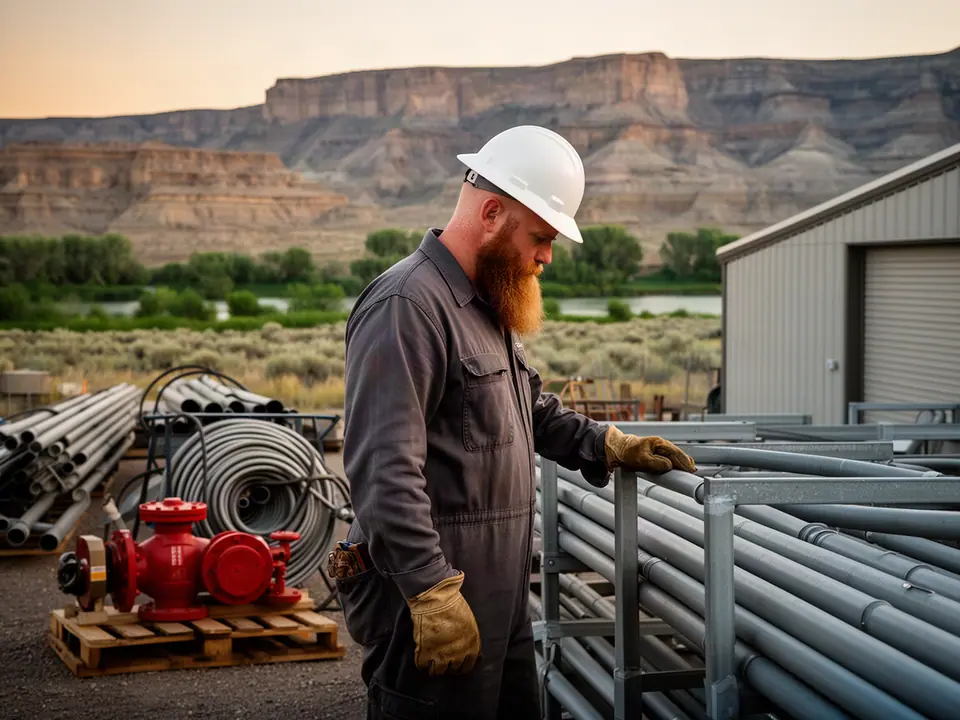
The request goes from Ridgehollow Finance to funding partners; each one weighs the quote against the company records and sets its own terms, if it offers any. Crew wages fit working capital.
Equipment financing fits pumps, pulling units and vacuum trucks that carry a title or serial number. Working capital or a line of credit fits crew payroll, spare parts and the first weeks around a new unit. Whether terms are offered is up to the partner reviewing the request.
At a glance
- Oil and gas support establishments, Sweetwater County, WY
47 with paid staff (CBP 2023, NAICS 213112)
- Fewer than five employees, same code and county
15 establishments, 31.9% (CBP 2023)
- Annual payroll, same code and county
$61.8 million (CBP 2023)
- Same code, ZIP 82935
5 employer establishments (ZBP 2023)
Oilfield Financing Company When a Green River, WY Oilfield Service Company Needs Pressure Pumps
A trailer-mounted pressure pump arrives with a make, a model, a serial number and a seller's price. Those details are what equipment financing is written around: the pump secures the agreement, and the term can be set against the years the power end and fluid end are expected to run.
Ridgehollow Finance sends that pump request on to funding partners that finance machinery. Each partner can read the quote, the pump's age and hours, and the company's bank statements before it decides whether to offer terms, and a used unit may also need an inspection report or photos of both ends.
An "oilfield financing company" in this sense is any partner willing to take a titled or serial-numbered machine as collateral. The pump and the trailer it rides on carry their own identification, so both can sit in one request.
Financing for Oilfield Payroll and Spare Parts: Notes for Green River, WY Oilfield Service Companies
Oilfield service work can be billed after the job ticket is signed, on the operator's payment terms. The crew is paid on its own schedule, and parts and fluids for the next job are bought before the last one is paid. Nothing in that gap can be titled, which makes it a working capital matter rather than an equipment one.
Illustration only, invented figures: a crew payroll of $14,600 every two weeks and an operator that pays 45 days after the ticket. Count the paydays on a calendar: the wait holds 3 or 4 of them, by where the first one sits, which puts $43,800 to $58,400 of wages out before the operator's check clears.
Spare parts are their own line. Packing, valve seats, hoses and filters held for the next breakdown are stock; a large parts order can go to inventory financing or a draw on a line of credit that is paid down when the operator's check arrives. Rig-up and insurance bills are added in the net-60 working capital article, and the funding-process article covers what a partner reviews while invoices are open.
Oil and Gas Equipment Financing: Pulling Units Bought Outright or Leased
A pulling unit, the workover rig that pulls rods and tubing, can be the largest single purchase a well-servicing company makes. Buying it through equipment financing or a loan leaves the company holding the title once the balance is paid.
A lease ties the payment to the years of use instead. At the end, depending on the lease, the company returns the unit, renews or pays a buyout. Which route costs less depends on the term and that buyout, so the fair comparison is the total of every payment plus any buyout, not the monthly figure alone.
Either way, a partner can ask for the rig's inspection, its hours and any master service agreements that show where it is expected to work. Invented lease and purchase totals for one unit are set out in the lease-or-buy article.
Oil Field Financing for Rig-Up Costs When a Vacuum Truck Joins the Fleet
Adding a vacuum truck brings two kinds of cost. The truck has a VIN and a quote, so it fits equipment financing. The first weeks around it do not: a driver's wages before the truck bills its first load, registration and permits, hoses and fittings, and the days spent moving onto a new location.
Those rig-up costs leave nothing to title. A partner can look at them through working capital or a line of credit, so a call that names both the truck quote and an estimate of the first weeks lets the partner see the whole picture at once.
Support Activities for Oil and Gas Operations in Sweetwater County, WY: Size and Payroll
The county figures on this page come from the 2023 County Business Patterns (CBP) for NAICS 213112, support activities for oil and gas operations: contract work done for operators, such as running and pulling casing and rods, cementing, acidizing and cleaning out wells.
Small crews are the minority in that code. In Sweetwater County, WY, 31.9% of the 47 establishments counted for 2023 (15) had under five employees, and the other 32 had five or more. Together they reported $61.8 million in annual payroll and 707 paid employees in the March pay period.
ZIP Code Business Patterns, which places a business by its physical address, put 5 establishments in this code inside ZIP 82935 in 2023.
Nonemployer Statistics use a broader code for owners with no paid staff: support activities for mining (NAICS 21311) had 17 such businesses in the county in 2024. Trades beyond the oilfield are grouped on the industries page, and county-wide figures sit on the Green River, WY page.
By Ridgehollow Finance · Updated